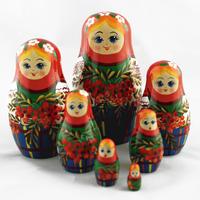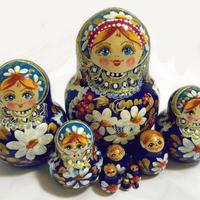
- Seasoned linden wood, nothing else
- Turned on a lathe and painted by hand in Russian workshops
- A seam that grips, under several coats of clear lacquer
The short answer
Most old nesting dolls are worth a modest amount: enough to be worth keeping, rarely enough to change anything. A Soviet-era souvenir set in good condition typically sits in the low tens of euros. A signed, finely painted set by a known artist can reach several hundred or more. Pre-revolutionary sets from the first decades are genuinely rare and belong in the auction-house category.
The difficulty is that these three categories look broadly similar to somebody who does not know what to look for. So here is what to look for.
First, work out roughly how old it is
Age is the first filter, and you can narrow it a long way without any expertise.
- Pre-1917 sets are scarce. Expect hand-cut irregularity, soft matte gouache with no plastic sheen, and often no maker's mark at all. If you genuinely have one, get it looked at professionally rather than trusting an online guide.
- Soviet period, roughly 1930s to 1991, is where the great majority of inherited sets fall. Look for a factory stamp, sometimes a price stamped directly into the wood in kopecks, and consistent, competent, repetitive painting.
- Post-1991 sets are usually signed by an individual artist rather than stamped by a factory, and the painting is often far more elaborate than Soviet production work.
- Recent tourist production is bright, thickly lacquered, and often not linden at all.
A stamped price is a useful clue
Soviet factory sets frequently carry a retail price stamped or burned into the base in kopecks. It tells you two things immediately: the set is genuinely of that period, and it was made for domestic sale rather than the tourist trade.
What actually drives value
In rough order of importance:
- Who painted it. A signed set by a recognised artist is worth multiples of an unsigned equivalent. This is the single biggest factor, and it is why our guide to reading signatures and hallmarks is worth ten minutes of your time.
- Quality of the painting. Fine brushwork, individual faces, gold leaf, and detail that continues onto the smallest figures. Compare the innermost doll of two sets and the difference in skill is usually obvious.
- Completeness. A set missing one figure loses a large part of its value, and a set missing the smallest is worth noticeably less than one missing a middle doll.
- Condition. Cracks, water damage, flaking lacquer and overpainting all reduce value. Honest wear does not, particularly on a genuinely old piece.
- Piece count. Ten, fifteen and twenty-piece sets are harder to turn and were made in smaller numbers.
- Subject. Political sets, fairy-tale narratives and unusual commissions often outperform standard flowered figures.
How to check completeness properly
Open the whole set and line the figures up. Each doll should nest inside the next with no large gap and no forcing. A replacement figure from another set is usually detectable: the painting style shifts slightly, the wood tone differs, or the fit is noticeably looser or tighter than the rest of the sequence.
Count carefully too. People describe a set by the number of dolls, and a "ten-piece" set with nine figures is a different object commercially.
What to look at underneath
Turn every doll over. The base carries most of the information:
- A signature, usually in Cyrillic, sometimes with a place name and a year.
- A factory stamp, often circular, indicating Soviet-era production.
- A numbering such as 12/50, which indicates a limited series and is a strong positive signal.
- Nothing at all, which is common on both very old sets and cheap modern ones, so an absent mark tells you little on its own.
Telling old from artificially aged
Deliberately distressed "antique" sets are sold widely. A few things separate genuine age from staged age:
- Wear sits where hands go. Genuine wear concentrates on the seam, the base rim and the widest part of the body. Even, all-over distressing is applied, not earned.
- Lacquer yellows unevenly. Old varnish ambers most where light reached it, so a set that is uniformly amber including the inside has been tinted.
- Old gouache is dead matte under the varnish. Modern acrylic underneath has a faint plastic quality even when varnished.
- Smell the inside. Old linden smells faintly of dry wood. Fresh solvent or a chemical smell is a recent finish.
Should you clean or restore it?
Almost always no. Overpainting destroys value completely, and even careful cleaning can lift original gouache through cracked varnish. Dust with a dry soft cloth and stop there. If a set is valuable enough to be worth restoring, it is valuable enough to be worth a conservator rather than a kitchen table.
Do not attempt to force a stuck set apart either. Our guide on opening a tight set safely explains the technique; a split rim is permanent damage.
Where to get a real valuation
Completed auction results are the only honest price signal. Asking prices on marketplaces tell you what sellers hope for, not what buyers pay. Search completed lots for comparable sets by piece count, period and artist, and be realistic about condition when comparing.
For anything you suspect is pre-revolutionary or by a named artist, a specialist in Russian decorative arts is worth the consultation fee.
If you are buying rather than valuing
Buying genuinely antique sets means accepting risk on condition, completeness and attribution. Many collectors start instead with new work by living painters: signed, complete, in known condition, and often better painted than mass-produced Soviet output. Our ten-piece sets and fairy-tale sets are where most collectors begin, and every set ships from Ukraine across the EU with delivery included.
Frequently Asked Questions
Are old Russian nesting dolls worth anything? +
Most are worth a modest amount: a Soviet-era souvenir set in good condition typically sits in the low tens of euros. A signed set by a recognised artist can reach several hundred or more, and genuinely pre-revolutionary sets are rare enough to warrant a specialist valuation. Who painted it matters more than how old it is.
How can I tell how old a matryoshka is? +
Look at the base. Soviet-era factory sets often carry a circular stamp and sometimes a retail price stamped into the wood in kopecks. Post-1991 sets are usually signed by an individual artist. Pre-1917 sets show hand-cut irregularity and soft matte gouache with no plastic sheen, and frequently carry no mark at all.
Does a missing doll reduce the value of a set? +
Considerably. A nesting doll set is valued as a complete sequence, and a missing figure removes a large part of the value, especially if it is the smallest one. Line the whole set up and check that each doll nests without forcing, since a replacement figure from another set usually differs slightly in painting style, wood tone or fit.
Should I clean or restore an antique nesting doll? +
No. Overpainting destroys the value entirely, and cleaning can lift original gouache through cracked varnish. Dust it with a dry soft cloth and leave it alone. If a set is valuable enough to justify restoration, it is valuable enough to justify a professional conservator rather than home treatment.