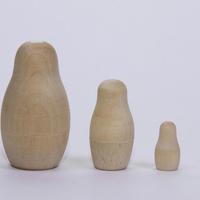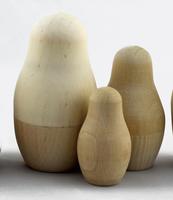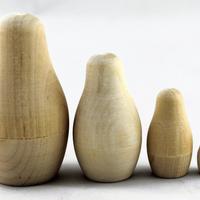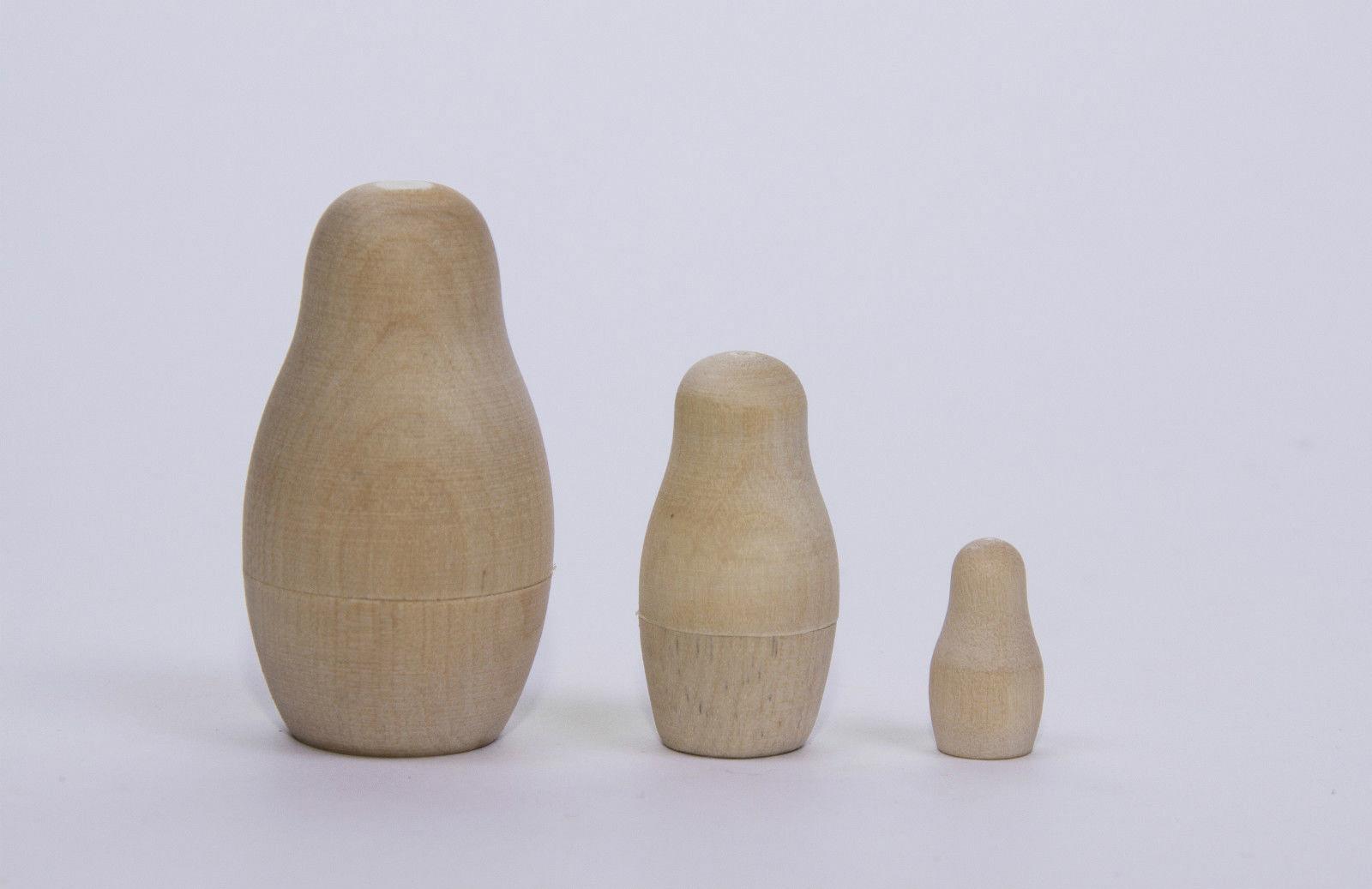
- Seasoned linden wood, nothing else
- Turned on a lathe and painted by hand in Russian workshops
- A seam that grips, under several coats of clear lacquer
What a blank nesting doll actually is
A blank is a finished nesting doll in every respect except the painting. The linden has been seasoned, the shells have been turned on a lathe, the seams have been cut to grip, and the surface has been sanded smooth. What you receive is bare, pale, faintly sweet-smelling wood, ready to take colour.
This matters because the hard part of making a matryoshka is not the decoration. It is the woodturning: cutting a series of shells that nest without sticking, and doing it in timber stable enough to still fit years later. Buying a blank means somebody else has already solved that problem for you.
Why blanks are always linden
Linden (Tilia cordata) has an even, almost knot-free grain, it is soft enough to turn thin, and it barely moves when humidity changes. Birch is harder and tears; pine has resin pockets that bleed through paint. Every serious blank you will find is linden, air-dried outdoors for two to three years before it reaches the lathe.
Choosing the right size to start with
The instinct is to buy the biggest set available. Resist it. The number of pieces multiplies the work: a five-piece set means ten surfaces to prime, paint and seal, because every doll has a top and a bottom.
- Three pieces is the honest beginner's set. You can finish it in an afternoon and learn every step without committing a weekend.
- Five pieces is the standard once you know what you are doing. It gives you a large outer doll worth putting real detail into and a smallest figure that is still comfortable to hold.
- Seven or ten pieces is for people painting seriously or working to a commission. The innermost dolls at ten pieces are under two centimetres, which needs a fine brush and a steady hand.
For classrooms and workshops, three-piece blanks bought in quantity work best. Everyone finishes, and nobody is left with an unpainted doll at the end of the session.
Preparing the surface
Blanks arrive sanded but not sealed. Bare linden is thirsty, and paint applied straight onto it will sink in and go blotchy. Two approaches work.
The traditional way is a thin starch primer. Russian workshops have used boiled potato starch for a century: brushed on thin, left to dry, then lightly smoothed. It seals the grain without filling it and leaves a slightly absorbent surface that gouache loves.
The modern way is one thin coat of clear acrylic gesso or diluted white acrylic, sanded back with fine paper once dry. It is faster, more forgiving, and it gives you a brighter base if you want strong colours.
Either way, keep the primer off the rim where the two halves meet. Paint there adds thickness, and thickness is exactly what turns a smooth seam into a stuck one.
Which paints work on linden
- Gouache is what the traditional workshops use. It is opaque, it layers well, and it dries matte, which is what gives old matryoshka their soft look. It must be varnished, or it will smudge.
- Acrylics are the easiest choice for most people. They are waterproof once dry, they need no fixing, and they come in every colour. They dry slightly plastic-looking, which varnish softens.
- Watercolour works only over a well-sealed surface, and only if you want a pale, washed look. On raw linden it will bleed along the grain.
- Egg tempera is the historical option and gives the most beautiful result, but you are mixing pigment with yolk and it has a short working life.
- Pyrography pens need no primer at all. Burn your outlines straight into the bare wood, then colour inside them if you want.
The order of work
Paint in the order the traditional workshops do, and the job gets easier:
- Face first. If the face goes wrong, you have lost nothing else. Traditionally the face is left on bare or barely tinted wood, with only the eyes, lips and a hint of cheek painted in.
- Headscarf and outline. Block in the large shape that frames the face. This fixes the proportions of everything that follows.
- Body colour. The apron or dress field, flat and even.
- Decoration. Flowers, leaves and pattern, painted over the dry body colour.
- Fine lines last. Outlines, eyelashes and details, once nothing underneath can smudge.
Do every doll in the set stage by stage rather than finishing one at a time. Mixing a colour twice never gives you the same colour, and a set painted one doll at a time drifts in tone from largest to smallest.
Sealing your work
An unvarnished doll will mark the first time somebody handles it. Two or three thin coats of clear water-based polyurethane or acrylic varnish is enough. Thin coats, fully dry between each; a single thick coat stays tacky in the seams for weeks and glues the set shut.
Gloss is traditional and makes colours look deeper. Matte is more forgiving of uneven brushwork. Whichever you choose, keep varnish off the inner rim for the same reason you kept primer off it.
The one mistake everyone makes
Painting or varnishing the mating rim. Even one extra coat of paint on the inner lip is enough to make a doll that will not close, or worse, one that closes and will not open again. Mask it, or simply keep your brush away from the last few millimetres.
Blanks for children
Unpainted sets are a good children's project because there is nothing to get wrong: the wood is already safe, smooth and splinter-free. Use water-based acrylics or child-safe poster paint, and do the varnishing yourself afterwards. For under-threes, choose three-piece sets so no component is small enough to swallow.
What to expect from the wood itself
Blanks are handmade objects, not machined ones. Expect faint tool marks from the lathe, small colour variation in the grain, and a seam that grips firmly when new. None of these are faults. A new set that feels tight will ease after a few openings, and a little dry wax on the bare inner rim speeds that up. If you want the full background on why the wood behaves as it does, our guide to how nesting dolls are made covers the seasoning and turning in detail.
Ready to start? Our unpainted linden blanks come in three to ten pieces, sanded and ready to prime, and ship from Ukraine to every EU country with delivery included.
Frequently Asked Questions
What paint is best for blank wooden nesting dolls? +
Acrylics are the easiest and most durable choice: opaque, waterproof once dry, and no fixing required. Gouache is what traditional Russian workshops use and gives the authentic matte look, but it must be varnished or it will smudge. Whichever you use, seal the bare linden with a thin primer first, or the paint will sink into the grain and go blotchy.
Do I need to prime or sand a blank nesting doll before painting? +
Blanks arrive sanded, so you rarely need to sand further. You do need to prime. One thin coat of clear gesso, diluted white acrylic or the traditional boiled starch primer seals the thirsty linden so colour sits on the surface instead of soaking in. Keep primer off the rim where the halves meet, because added thickness there is what makes a set stick.
How many pieces should a first blank set have? +
Three. A five-piece set means ten painted surfaces, since every doll has a top and a bottom, and most beginners lose patience before the smallest figure. Three pieces can be finished in an afternoon and teaches every step of the process.
Are unpainted nesting dolls safe for children to paint? +
Yes. The wood is sanded smooth, splinter-free and untreated. Use water-based acrylics or child-safe poster paint and do the varnishing yourself. For children under three, choose three-piece sets so that no doll in the set is small enough to be a choking hazard.