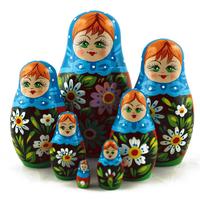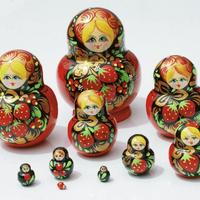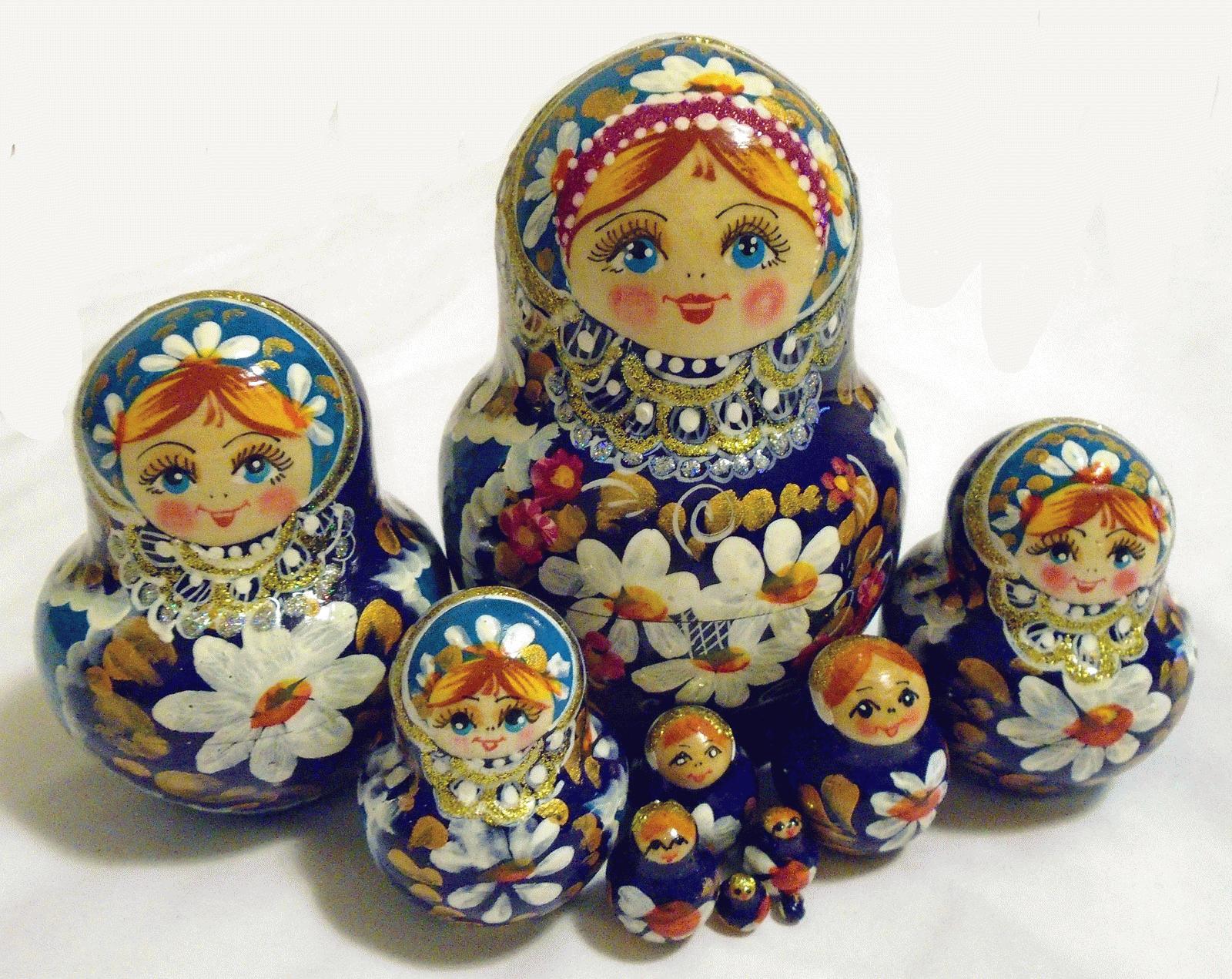
- Seasoned linden wood, nothing else
- Turned on a lathe and painted by hand in Russian workshops
- A seam that grips, under several coats of clear lacquer
The short answer
A traditional Russian nesting doll set holds between 3 and 20 figures. The original 1890 set by Vasily Zvyozdochkin held eight. Today the common counts are 3, 5, 7 and 10, with 15 and 20 made as collector pieces. Nothing about the tradition fixes the number: a set holds as many dolls as the woodturner can cut shells for while keeping every seam gripping.
What the number really decides is size, price and how much painting you get to look at. Here is how each count behaves in the hand.
3 pieces: the miniature
Roughly 5 to 9 cm tall, and the cheapest way to own real hand-painted work. Three pieces is too few to feel like a proper matryoshka in an adult's hand, but it is the right size for a child's pocket, a desk, a stocking filler or a first purchase to judge a workshop's brushwork before committing to something larger.
Because the innermost figure of a 3-piece set is still comfortably large, it is also the safest count for toddlers. Browse the 3-piece sets to see the range.
5 pieces: the standard gift
Usually 10 to 15 cm. Five is the count most people picture when they think of a nesting doll, and it is the one that gives the best ratio of impact to price. The outer doll is big enough for detailed painting, the innermost is small enough to be charming, and the set still fits comfortably on a shelf.
If you are buying a present and have no other information, buy five. See the 5-piece collection.
7 pieces: the collector's entry point
Typically 15 to 20 cm. Seven is where the painting starts to be worth studying: there is enough surface on the outer figures for a full folk scene, and enough steps in the sequence to see how an artist keeps a motif consistent as it shrinks. This is the count most Semenov workshops treat as their showcase size.
It is also the count most often ordered as a wedding or anniversary present, because the sequence of seven reads as a family line. The 7-piece sets are our largest single category.
Piece count is not a quality grade
A carelessly painted 15-piece set is worth less than a beautifully painted 5-piece one. Count tells you about the woodturning ambition, not the brushwork. Judge the painting on the smallest two figures: that is where a weak hand shows.
10 pieces: where the woodturning gets hard
Around 20 to 25 cm. At ten shells the turner has to hold a consistent wall thickness across a wide range of diameters, and every seam has to grip without binding. A 10-piece set that opens smoothly from top to bottom is proof of a good lathe hand. The innermost figure is usually 1 to 1.5 cm and solid.
Ten is the most popular count among European collectors, and it is what most people mean when they search for a "big" set. See the 10-piece collection.
15 and 20 pieces: the collector's tower
25 cm and up, and a different order of work. Above about twelve shells the smallest figures approach the limit of what can be turned and painted at all: the innermost doll in a 20-piece set is often smaller than a grain of rice is long, and painting a face on it takes a brush of a few hairs.
These sets take weeks rather than days, they are made in small numbers, and they are priced accordingly. If you want one object that demonstrates the whole craft, this is it. See the 15-piece and 20-piece sets, or read our guide to large and giant nesting dolls.
How height and price scale with count
Height does not double when the count doubles. Each additional shell adds only the thickness of two walls plus a small step, so a 10-piece set is not twice the height of a 5-piece set; it is perhaps 60% taller and considerably heavier. Price scales faster than height, because every extra shell is another piece to turn, prime, paint and lacquer, and because the failure rate rises: a split at shell fourteen ruins the whole set.
| Pieces | Typical height | Best for |
|---|---|---|
| 3 | 5-9 cm | Children, desks, first purchases |
| 5 | 10-15 cm | The standard gift |
| 7 | 15-20 cm | Detailed painting, weddings, display |
| 10 | 20-25 cm | Collectors, statement pieces |
| 15-20 | 25 cm+ | Serious collecting, heirlooms |
Which one should you actually buy?
Buying for a child under three: 3 pieces, and check our note on nesting dolls and toy safety. Buying a present for an adult: 5 or 7. Buying something to keep and look at for twenty years: 10. Buying to demonstrate what the craft can do: 15 or 20. Buying to paint yourself: pick the count by patience, five is an afternoon, ten is a project.
Frequently Asked Questions
How many dolls are in a Russian nesting doll set? +
Between 3 and 20. The commonest counts are 3, 5, 7 and 10; 15 and 20-piece sets are made as collector pieces. The original 1890 matryoshka held eight figures.
What is the most popular nesting doll size? +
Five pieces for gifts and seven for display or collecting. Five gives the best balance of size, painting detail and price; seven is the size most Semenov workshops treat as their showcase.
Is a 10-piece set twice the size of a 5-piece set? +
No. Each extra shell adds only two wall thicknesses plus a small step, so a 10-piece set is roughly 60% taller than a 5-piece one, though noticeably heavier and considerably more expensive to make.
What is the largest nesting doll set ever made? +
Record sets have run to dozens of figures, but above about twenty pieces the innermost dolls become too small to turn hollow and are carved solid. In normal production, 20 pieces is the practical ceiling.