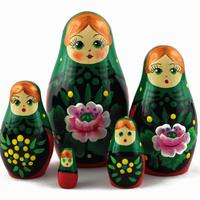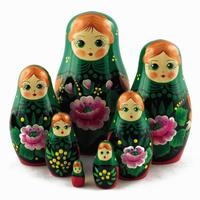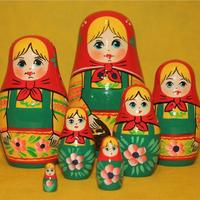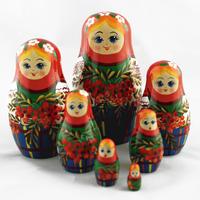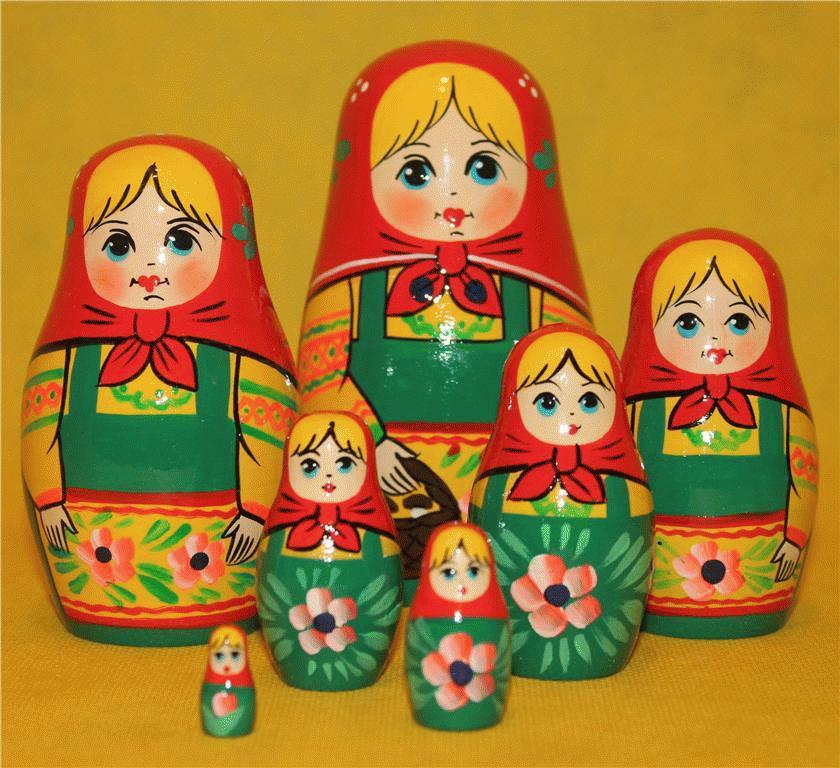
- Seasoned linden wood, nothing else
- Turned on a lathe and painted by hand in Russian workshops
- A seam that grips, under several coats of clear lacquer
What the doll means before it means anything else
The matryoshka's core symbolism is not decorative. The name descends from Matryona and behind it the Latin mater, mother; the original 1890 set opened on a swaddled infant in a cradle. A figure that contains successively smaller versions of itself, ending in a baby, is a picture of generational continuity: mother, daughter, granddaughter, on down. That is the meaning people are usually reaching for when they choose the image for a tattoo.
Our fuller treatment is here: matryoshka meaning and symbolism.
The four readings people usually choose
- Motherhood and family line. The commonest reading. A set of three or four dolls, one per generation, often with the smallest carrying a birth year.
- The hidden self. The doll as a picture of interiority: the public figure outside, smaller and more private selves within. This reading is why the image turns up so often alongside anatomical or surrealist work.
- Protection. The outer shell as something that holds and shields what is inside. Popular as a memorial piece for a parent or grandparent.
- Slavic heritage. Straightforward cultural identification, usually rendered in the recognisable Semenov palette of yellow headscarf and red roses.
One caution on symbolism
The doll is a folk object, not a religious one. It carries no sacred meaning in Orthodox practice, and claims that it represents a specific spiritual doctrine are modern inventions rather than tradition. Its weight comes from family, not from liturgy.
Design styles and what they change
Traditional folk. Flat colour, black outlines, yellow or red headscarf, a bouquet of roses and daisies on the apron. Reads as heritage and warmth, and ages well because the design is built from bold shapes.
Neo-traditional. Heavier line weight, limited palette, decorative framing. The most common modern approach, and the most durable at small sizes.
Blackwork and linework. The silhouette alone, or a cutaway showing the dolls nested inside one another. Emphasises the structural idea rather than the folk decoration.
Anatomical or surreal. The doll opened to show something other than a smaller doll: a heart, a bird, a skull. This is where the "hidden self" reading lives.
Placement and size
The design carries an inherent vertical stack, so it suits forearms, calves and spines better than it suits wide flat areas. If you want several dolls in a row, plan for at least 4 cm per figure: below that the faces lose their features within a decade, and the face is the part that makes the image read as a matryoshka rather than a skittle.
Where the imagery comes from
If you are designing a piece and want the details right, the regional styles are genuinely distinct: Semenov's unpainted wooden face and yellow scarf, Sergiev Posad's opaque village scenes with black ink outlines, Polkhov-Maidan's crimson rose hips and aniline dyes. Copying one of them properly reads as informed; mixing all three reads as a stock image. Our guide to regional styles shows what separates them, and a real set on the desk beats a reference photo, since the painting is built from layered strokes a photograph flattens.
Frequently Asked Questions
What does a matryoshka tattoo mean? +
Most often motherhood and the family line, since the doll contains successively smaller generations ending in an infant. It is also read as the hidden or private self, as protection, and as straightforward Slavic heritage.
Does the matryoshka have a religious or spiritual meaning? +
No. It is a folk object created in 1890 as a workshop toy, with no role in Orthodox religious practice. Claims of a specific spiritual doctrine behind it are modern additions rather than tradition.
How big should a nesting doll tattoo be? +
At least 4 cm per figure. Below that the painted face loses definition as the tattoo ages, and the face is what makes the shape read as a matryoshka rather than a generic skittle silhouette.
Which painting style should I copy for a design? +
Pick one region and follow it. Semenov uses a bare wooden face and yellow headscarf with roses; Sergiev Posad paints opaque village scenes with black outlines; Polkhov-Maidan uses crimson rose hips in bright aniline dyes.