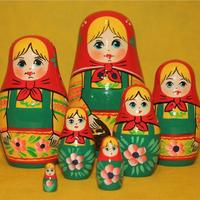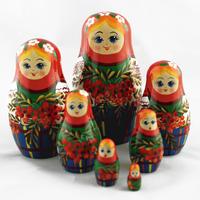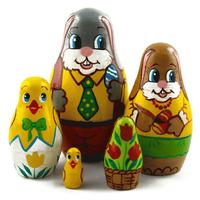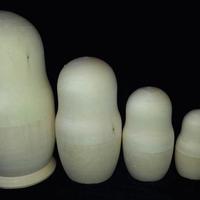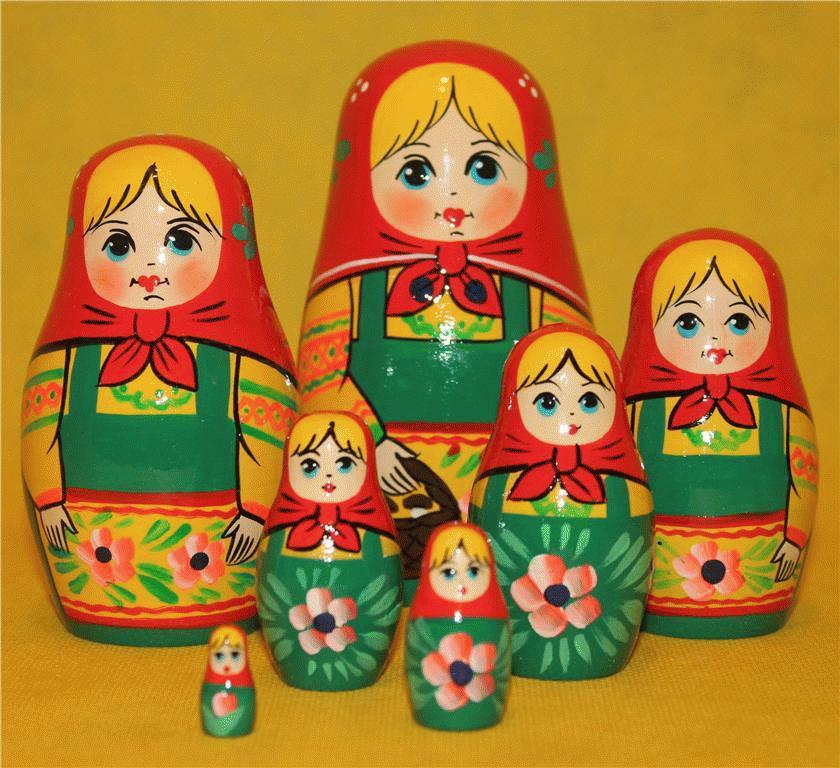
- Seasoned linden wood, nothing else
- Turned on a lathe and painted by hand in Russian workshops
- A seam that grips, under several coats of clear lacquer
Where the name comes from
The word matryoshka is a diminutive of Matryona, a common Russian peasant name of the nineteenth century. Matryona traces back through Latin to mater, mother. So the name of the object is, quite literally, a small mother.
That etymology is the whole of the symbolism in one word. Everything else people say about nesting dolls is an elaboration of it.
The other name you will hear is babushka, which means grandmother in Russian and is not what the doll is called in Russia at all. It caught on in English because the outer figure wears a headscarf, and a headscarf reads as grandmother to English speakers. Both names point at the same object. We have written about that distinction in more detail in matryoshka versus babushka.
What the layers represent
The traditional reading has three strands, and they overlap.
- Motherhood. A figure that opens to reveal another figure inside it is a fairly direct image of pregnancy and of one generation carrying the next.
- Family and continuity. The set read outward is a line of descent. Each doll contains and protects the one after it, and nothing in the set exists on its own.
- Fertility and abundance. A single outer shell that turns out to hold many figures was, in a rural nineteenth-century context, a straightforwardly hopeful image.
The very first set painted by Sergey Malyutin in 1890 made this explicit: a peasant girl in a headscarf holding a black rooster, opening to reveal boys and girls at rural tasks, down to a swaddled baby at the centre. The sequence was the point.
The centre matters
In a traditional set the innermost figure is usually a baby, and unlike every other doll it is solid rather than hollow. It does not open. The sequence has to stop somewhere, and the point at which it stops is the newest life in the family.
What matryoshka do not mean
A few claims circulate widely and are worth correcting.
They are not ancient. The matryoshka is not a medieval Slavic tradition. The first one was turned in 1890 at the Abramtsevo estate workshops outside Moscow, and it was inspired in part by Japanese nested figures from Honshu. It is a little over a century old.
They are not religious objects. There is no ritual attached to them and no meaning assigned to individual colours in any traditional sense. Painters choose palettes by region and by eye.
They were not a folk craft that grew from the villages. It happened the other way round: the matryoshka was designed in an arts-and-crafts workshop by educated artists interested in reviving folk style, and only then spread to the village workshops that made it a genuine tradition.
None of this makes the symbolism less real. It just makes it younger than people assume.
Why the image travelled so far
The matryoshka won a bronze medal at the Paris Exposition Universelle in 1900 and orders followed almost immediately. But the reason it spread beyond souvenir shops is that the structure is a very good metaphor, and it is legible without explanation.
- In psychology and therapy, nested dolls are used to talk about the layers of a personality, or the child a person still carries inside the adult.
- In philosophy and science writing, "matryoshka" has become shorthand for anything recursively contained: nested structures, systems inside systems.
- In tattoos, the doll usually stands for motherhood, for family lineage, or for the wearer's own hidden layers. It is one of the most common Slavic-derived tattoo motifs precisely because it needs no caption.
- In design and branding, the shape signals warmth, family and craft in a single silhouette.
Regional meaning in the painting
Individual sets carry more specific meaning through what is painted on them, and that varies by workshop tradition.
- Semenovo sets carry big scarlet roses on a yellow ground. The flowers are decorative rather than symbolic, but the palette is instantly recognisable as a marker of place.
- Sergiev Posad sets, from the town where the first doll was made, often show village scenes, pilgrims and everyday work, which reads as a portrait of a community rather than a family.
- Fairy-tale sets retell a specific story across the figures: the Firebird, Tsar Saltan, Vasilisa. Here the sequence is narrative, and the dolls are chapters.
- Winter sets with Father Frost and the Snow Maiden attach the object to a season rather than a lineage.
If you want to see how the regional styles differ in practice, our guide to regional painting traditions sets them side by side.
Choosing a set for its meaning
If you are buying a matryoshka as a gift with intent behind it, the piece count carries meaning as readily as the painting. A set with as many figures as there are people in a family is the oldest use of the object. A set given at a birth, with the solid baby at its centre, says something specific. And a set painted with a particular story is a way of giving somebody that story in an object they can take apart.
You can browse by piece count or by painting tradition, and every set ships from Ukraine to the whole EU with delivery included.
Frequently Asked Questions
What do matryoshka dolls symbolise? +
Motherhood, family and continuity. The name itself is a diminutive of Matryona, which traces back through Latin to mater, mother, so the object is literally called a little mother. A figure that opens to reveal another inside it reads as one generation carrying the next, and the traditional innermost figure is a solid baby that does not open.
Are Russian nesting dolls an ancient tradition? +
No. The first matryoshka was turned in 1890 at the Abramtsevo estate workshops outside Moscow, partly inspired by Japanese nested figures. It is a little over a century old, and it was designed by educated artists reviving folk style rather than emerging from village craft. It only became a village tradition afterwards.
What does a matryoshka tattoo mean? +
Most commonly motherhood, family lineage, or the wearer's own hidden layers. The image is popular as a tattoo precisely because the structure explains itself: figures held inside figures needs no caption. There is no fixed traditional meaning attached to particular colours.
Why is the innermost doll solid? +
Because the sequence has to end somewhere, and in a traditional set it ends at the newest life in the family. The smallest figure is usually a swaddled baby, and unlike every other doll in the set it is turned from solid wood and does not open.