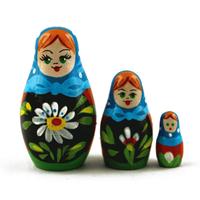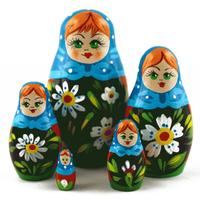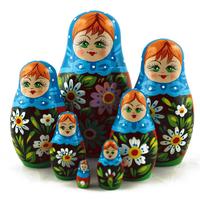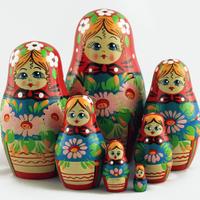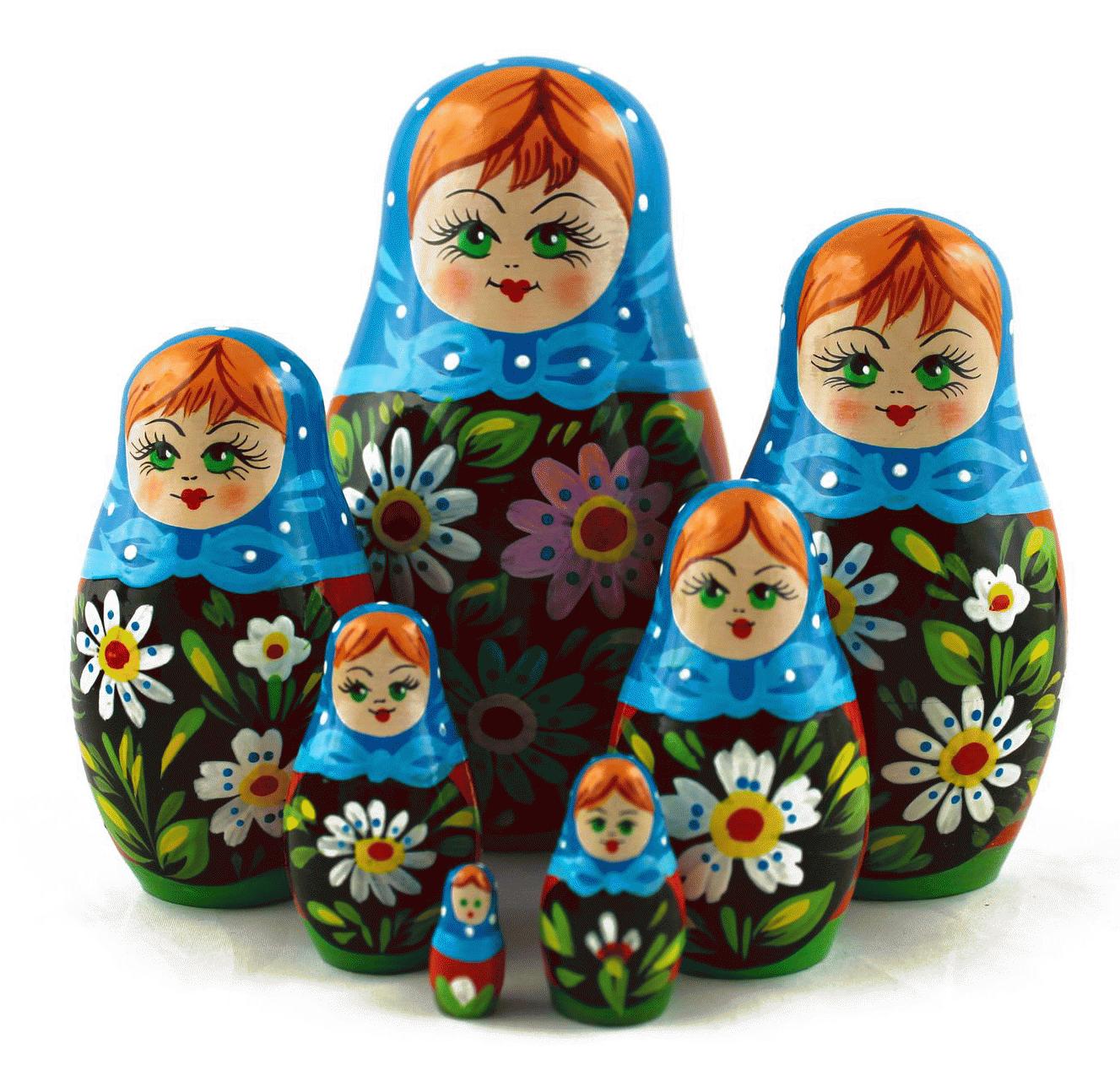
- Seasoned linden wood, nothing else
- Turned on a lathe and painted by hand in Russian workshops
- A seam that grips, under several coats of clear lacquer
The proper name is matryoshka
In Russian the doll is матрёшка, transliterated matryoshka and pronounced mah-TRYOSH-kah, with the stress on the middle syllable and a soft, quick "y" glide after the T. It is a diminutive of Matryona, a common peasant given name of the nineteenth century, which descends in turn from the Latin mater, mother. The name therefore carries the idea of motherhood inside it before the doll ever opens.
Everything else the object is called in the world is either a translation of what it does, or a misunderstanding that stuck.
Why so many people say babushka doll
Babushka (бабушка) means grandmother in Russian. It is not, and has never been, a Russian name for the doll. The word travelled west because the outermost figure wears a headscarf tied under the chin, exactly the way a Russian grandmother is pictured, and English speakers named the object after the woman it depicted. In Australia, South Africa and much of the UK, "babushka doll" is now the everyday term, and there is no point fighting it. Just know that if you use it in Russia or Ukraine, you will be asking for a grandmother.
We have a longer piece on this: matryoshka vs babushka dolls explained.
The descriptive English names
- Nesting dolls - the standard American term, describing figures that nest one inside another.
- Stacking dolls - used when the halves are lined up in a row rather than nested.
- Russian dolls - the commonest British term, and the vaguest, it names the country rather than the object.
- Matryoshka dolls - technically redundant, since matryoshka already means the doll, but universally understood.
How to pronounce it
matryoshka: mah-TRYOSH-kah. Not "matrix-ka", not "mat-roy-shka". The tricky part for English speakers is the try cluster, which is one soft sound rather than two syllables.
What they are called in each language
| Language | Name | Literally |
|---|---|---|
| Russian | матрёшка (matryoshka) | little Matryona / little mother |
| Ukrainian | матрьошка (matryoshka) | same root |
| Spanish | matrioska, muñeca rusa, mamushka | Russian doll |
| Portuguese | matrioska, boneca russa | Russian doll |
| Italian | matrioska, bambola russa | Russian doll |
| French | matriochka, poupée russe, poupée gigogne | nested doll |
| German | Matroschka, Matrjoschka, russische Puppen | Russian dolls |
| Dutch | matroesjka, Russische poppetjes | Russian dolls |
| Swedish | matrjosjka, ryska dockor, babushka docka | Russian dolls |
| Finnish | maatuska | from Russian matryoshka |
| Japanese | マトリョーシカ (matoryōshika) | transliteration |
The French oddity: poupée gigogne
French has its own word for the concept, older than the Russian doll itself. A gigogne figure is any object that contains a smaller copy of itself, from Mère Gigogne, a stock character in seventeenth-century French theatre: an enormous woman with children swarming out from under her skirts. The word now covers nesting tables and pull-out beds as well as dolls, and it still appears in French crossword clues for "poupée gigogne, 10 lettres".
Finnish maatuska and the sound of borrowing
Finnish maatuska shows what happens when a word crosses a language border: Russian consonant clusters are simplified, vowel harmony takes over, and the result no longer looks Slavic at all. Sweden's matrjosjka keeps the shape but respells it for Swedish orthography, which is why Scandinavian spellings look so different from German Matroschka.
Does the name change what you are buying?
No, and that is worth saying plainly, because sellers occasionally imply otherwise. A "babushka doll", a "matrioska" and a "nesting doll" are the same object under different labels. What decides quality is the wood, the turning and the brushwork, not the word on the listing. Our guide to identifying authentic nesting dolls covers what actually matters.
Frequently Asked Questions
What are Russian nesting dolls called? +
Matryoshka (матрёшка) in Russian. In English they are also called nesting dolls, stacking dolls, Russian dolls or babushka dolls; in Spanish matrioska or muñecas rusas, in French matriochka or poupée gigogne, in German Matroschka, in Finnish maatuska.
How do you pronounce matryoshka? +
mah-TRYOSH-kah, with the stress on the middle syllable. The 'try' is a single soft sound rather than two syllables.
What does matryoshka mean? +
It is a diminutive of Matryona, a common nineteenth-century Russian peasant name derived from the Latin mater, mother. The name carries the idea of motherhood, which is why the doll became a symbol of family and generational continuity.
Is babushka doll the correct name? +
Not in Russian, where babushka means grandmother. It is an English-language nickname taken from the headscarf the outer figure wears, and it is now standard usage in the UK, Australia and South Africa.